
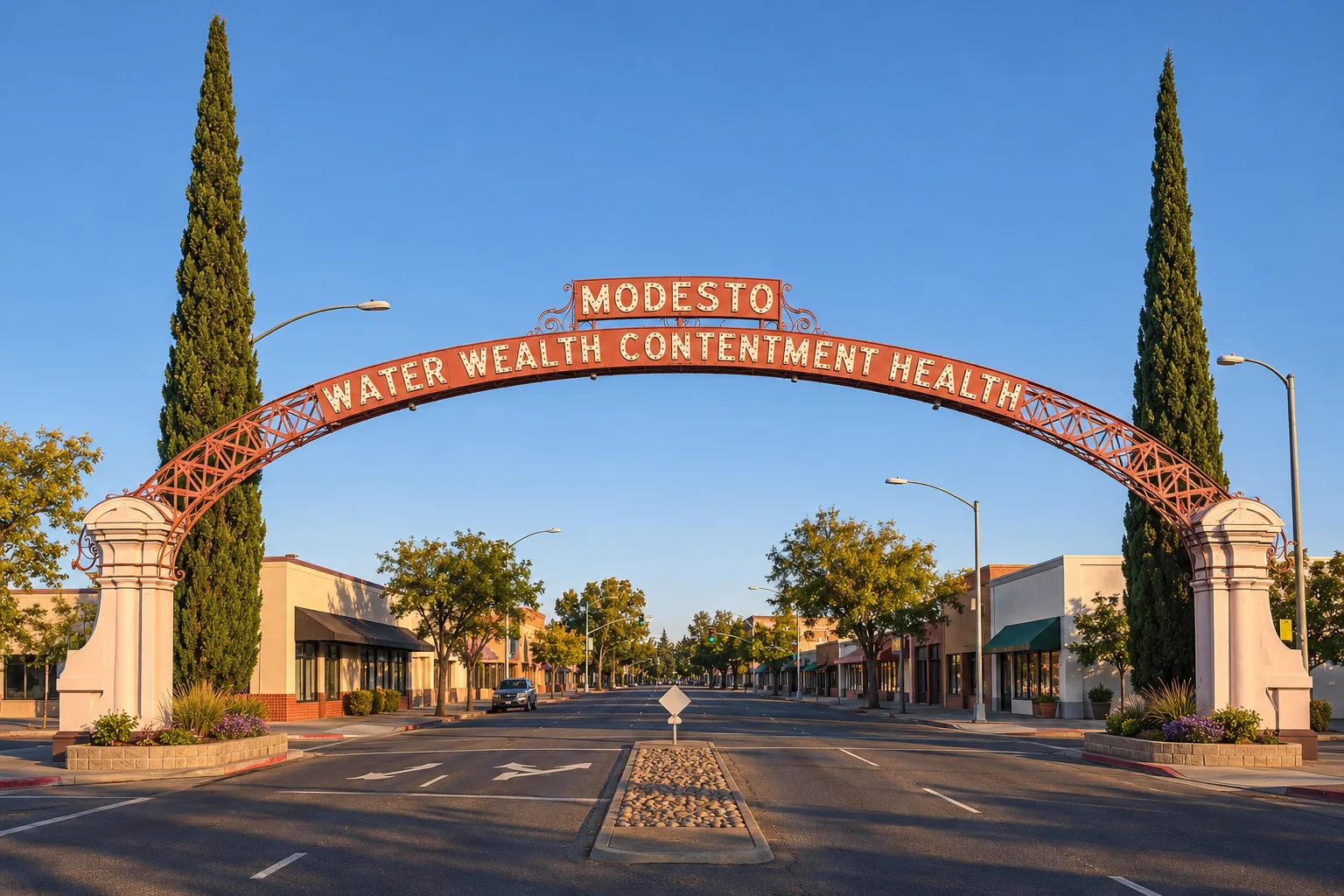
At Ninth and I streets, the Modesto Arch turns a downtown intersection into an introduction to the city. Its four-word message, “Water Wealth Contentment Health,” is easy to recognize. Understanding why those words were chosen takes you into a period when Modesto was promoting its future as eagerly as it was building it.
The Modesto Chamber of Commerce’s history dates the arch to 1912 and credits the Modesto Business Men’s Association and Modesto Boosters Club with its construction. The structure measures approximately 75 feet across and 25 feet high. Those proportions help explain its effectiveness. It addresses an entire street, making its message part of the experience of moving through downtown.
A Gateway for a Growing Railroad Town
The arch makes more sense when placed within the city that preceded it. Modesto developed as a railroad town in 1870. The city’s historical account of its founding and growth describes an original downtown grid organized around the rail line. Numbered streets followed its direction, while lettered streets crossed it. Rail service connected local wheat growers with wider markets.
That relationship between a city and its transportation network offers a useful way to read the arch. A gateway announces arrival, but it also tells people what kind of place they have reached. In Modesto’s case, the message emphasized resources, prosperity, and quality of life. The structure was public advertising with a civic purpose.
The same city history records Modesto becoming the county seat in 1871 and incorporating in 1884. By the time the arch appeared, the community had already spent decades developing civic institutions and commercial connections. Its position over a downtown street therefore matters. This was an announcement made within an established center of business and government, where a public landmark could connect the city’s practical activities with its preferred image.
The Slogan That Almost Won
A city history included in Modesto’s fiscal 2003 budget records the project’s beginnings. In 1911, Sol P. Elias presented a petition on behalf of the business association seeking permission for an illuminated ornamental arch. A contest also sought a city slogan and seal.
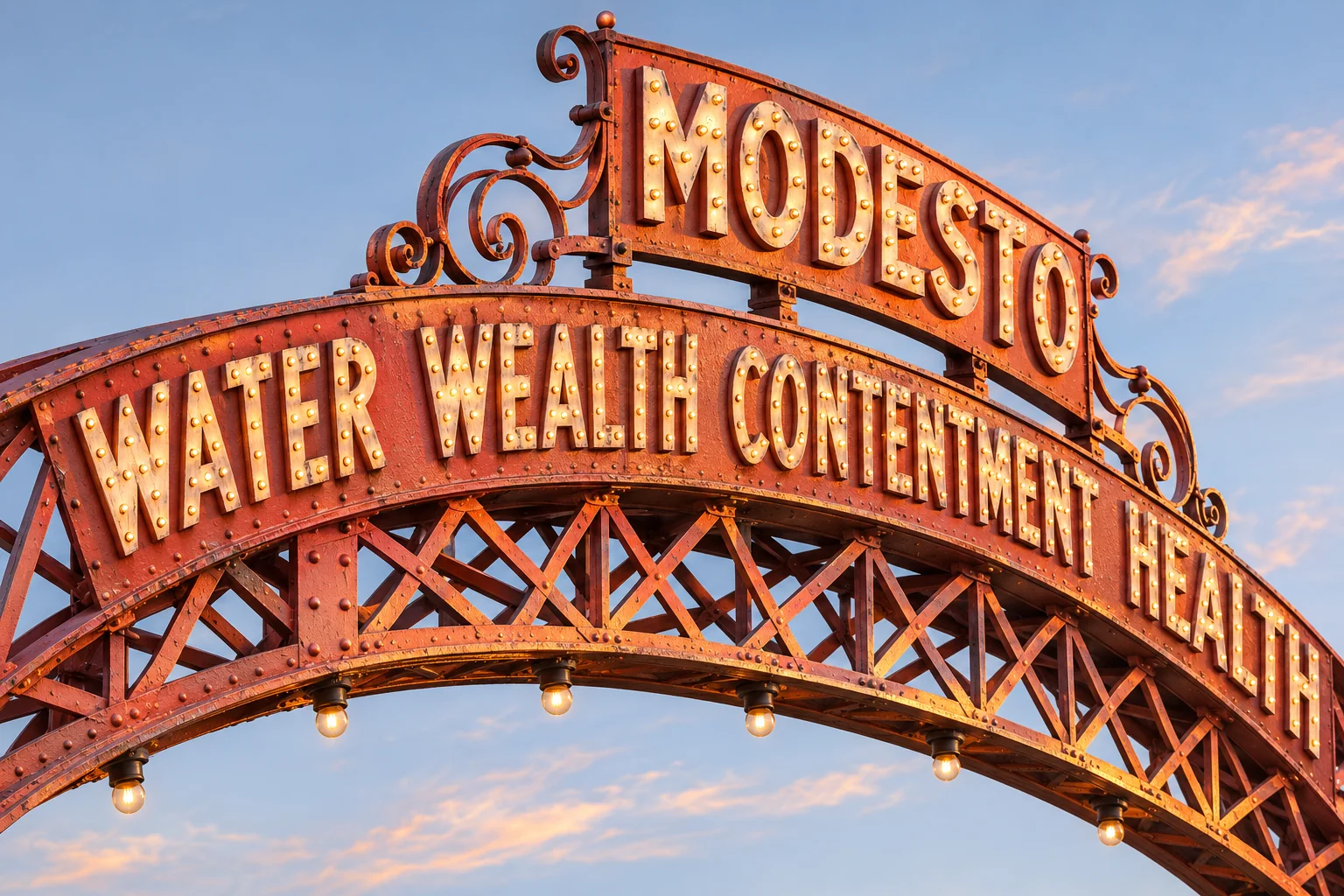
James Hanscom’s “Nobody’s Got Modesto’s Goat” received first prize. The association opposed that choice and supported the runner-up submitted by S. R. Harbaugh. His four-word entry became the wording displayed overhead. The familiar landmark therefore preserves a decision about how Modesto wanted to introduce itself. The rejected entry was playful and defiant; the selected phrase presented a more orderly picture of opportunity.
Why Water Comes First
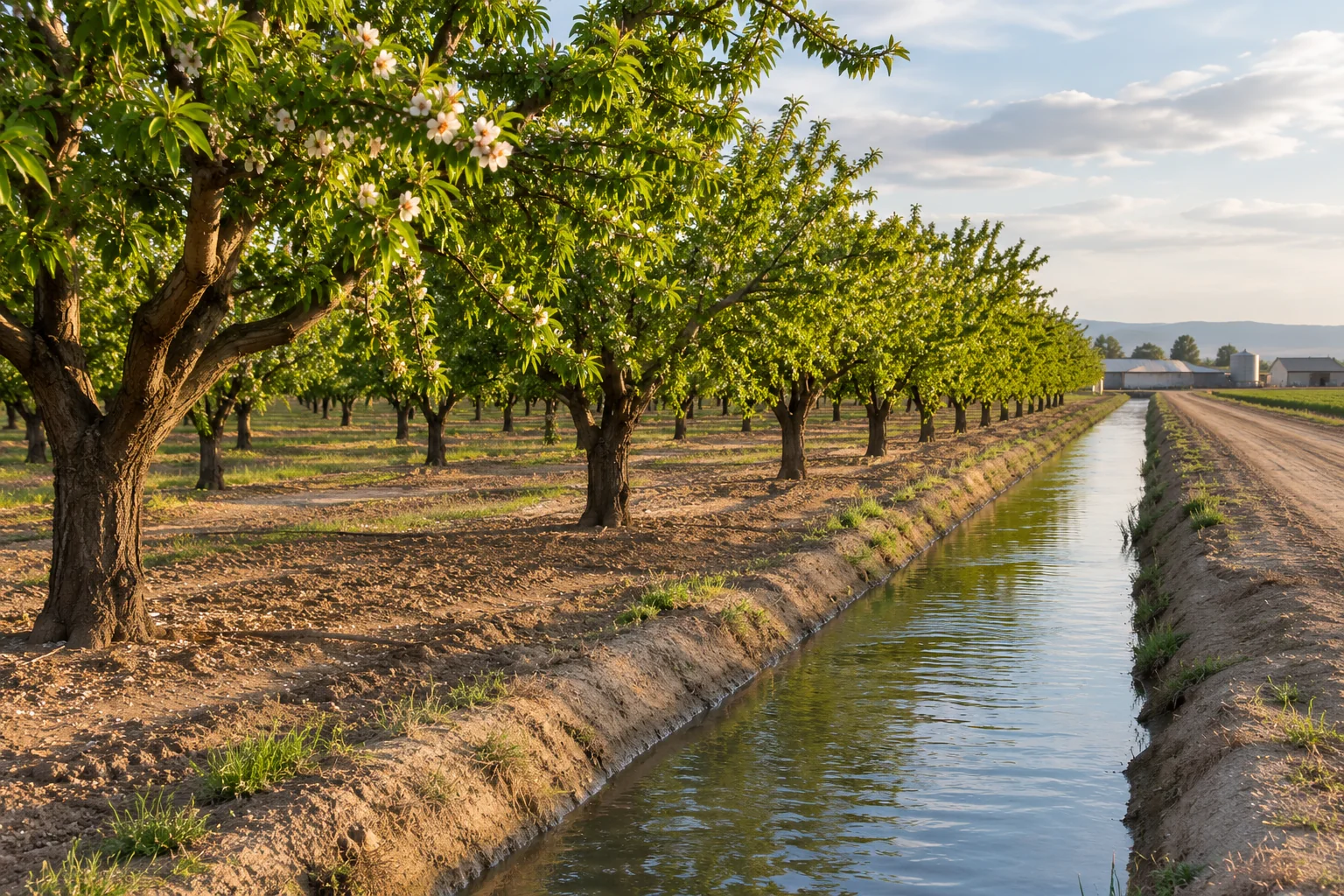
Water was a practical concern behind the city’s ambitions. The Modesto Irrigation District’s water history explains that its canals were completed in 1903 and its first official irrigation season began in 1904. Access to irrigation helped change the surrounding agricultural landscape, with orchards and vineyards replacing large areas of wheat.
Water and Wealth
Read the first two words as a relationship. Reliable irrigation could support crops that depended on water beyond seasonal rainfall. Agricultural production, in turn, helped sustain the businesses and services connected with farming. This interpretation follows the district’s account of agricultural change, while the slogan compresses that larger economic story into a few seconds of reading.
The district’s longer centennial history, The Greening of Paradise Valley, describes the 1904 irrigation jubilee and the public excitement surrounding the new system. The arch belongs within that atmosphere of promotion. Its confidence becomes easier to understand when irrigation is treated as an achievement people had worked toward, rather than as an invisible background service.
That history also records an increase in irrigated acreage from 6,895 acres in 1904 to 28,197 in 1910. These figures describe the irrigation district, rather than the city’s population or boundaries, but they show the scale of the surrounding transformation. Reading the inscription with that growth in mind connects a decorative downtown object with the working landscape beyond it. The countryside and the commercial center were parts of the same regional story.
Contentment and Health
The last two words broaden the promise beyond income. They invite the reader to imagine a satisfying place to live. That is an interpretation of the language, not a measurement of how every resident experienced the city. A civic slogan tells us what its promoters wanted to emphasize; it cannot summarize an entire community’s conditions.
Keeping that distinction in mind makes the arch more interesting. Instead of treating its inscription as a complete historical verdict, we can ask who chose it, which hopes it expressed, and how later generations have understood it. Familiar landmarks become useful historical evidence when their messages are read with curiosity.
A Landmark That Requires Care
The arch’s continued presence reflects work as well as affection. In its recent account of the landmark, the City of Modesto credits the Chamber of Commerce with restoring it a century after construction. The same city account places the arch within the work of local landmark preservation.
Restoration adds another layer to the story. People who commission a monument make one decision about a city’s identity. People who repair and retain it make another. The arch survives as a recognizable image because successive generations have considered that image worth carrying forward.
How to Look More Closely
Make Time for a Short Downtown Stop
Start by viewing the whole span from a public sidewalk. Notice how the wording, curve, and supporting columns work together. Then look along the street instead of concentrating only on the sign. The buildings, traffic, and street layout provide the setting that a tightly cropped photograph leaves out.
Photograph the Setting as Well as the Sign
Take one broad view that includes the intersection and another that concentrates on a detail. For your own records, note the date and viewpoint. If you later compare your photographs with a verified historical image, those details help you identify actual changes. Use pedestrian crossings and remain clear of the roadway while choosing a position.
Try the same exercise with someone who knows the city well. Ask what they notice first and which part of the view they remember differently. Their recollections can suggest questions to investigate, while dated photographs and records help establish the answers.
Continue the Story Through Downtown
The arch is a useful starting point for exploring different periods of Modesto history. Our guide to McHenry Mansion follows an earlier chapter through a family home and its preservation. Modesto and American Graffiti explores the city’s later relationship with cruising culture and film.
Seen together, these stories give the arch a wider setting. Its inscription captures one generation’s hopes, while the surrounding city holds many other experiences. The next time you pass beneath those familiar words, consider the people who selected them and the future they wanted visitors to imagine.