Modesto sits near the heart of California’s San Joaquin Valley, surrounded by some of the most productive agricultural land in the state. Yet the city did not begin as an agricultural center or a sprawling Central Valley community. The history of Modesto, California, is closely connected to the arrival of the railroad, the development of irrigation, changing architecture, agriculture, and a distinctive automobile culture that eventually became known far beyond the region.
From its beginnings in 1870 to today’s efforts to document and preserve historic buildings, Modesto’s story reflects many of the forces that transformed inland California. Understanding that story reveals why railroads, water, farmland, neighborhoods, landmarks, and even cruising all became important parts of the city’s identity.
How Modesto Began as a Railroad Town
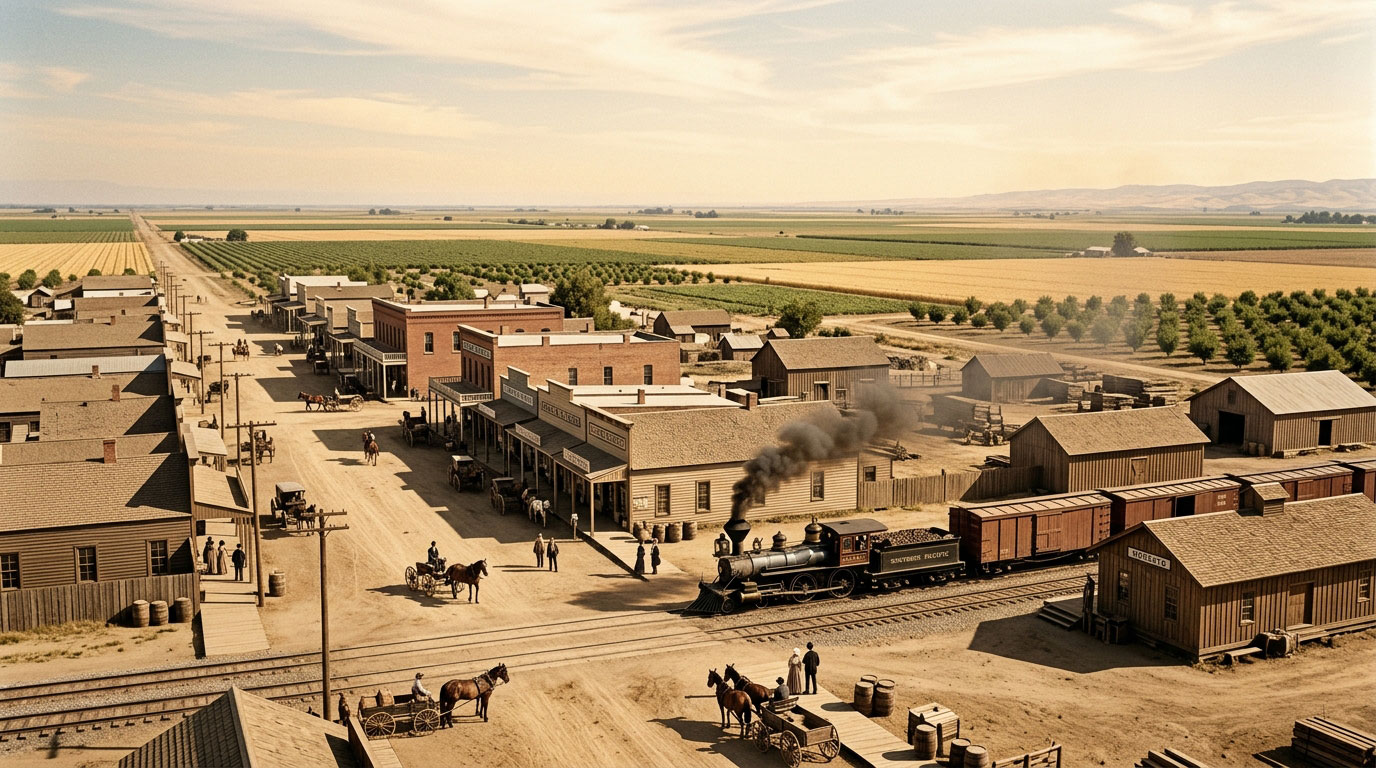
Modesto’s beginnings are tied directly to the expansion of the railroad through Stanislaus County. According to the Superior Court of California, County of Stanislaus, the new town was founded in 1870 as the Central Pacific Railroad established its route through the county.
The settlement was initially associated with the name Ralston, honoring William C. Ralston, an influential California businessman and railroad financier. Local accounts hold that Ralston declined the honor. His modest response ultimately inspired the name “Modesto,” derived from the Spanish word for modest.
Modesto Becomes the County Seat
The railroad quickly changed the geography of Stanislaus County. Older river communities that had once benefited from water transportation lost some of their importance as rail travel became increasingly significant.
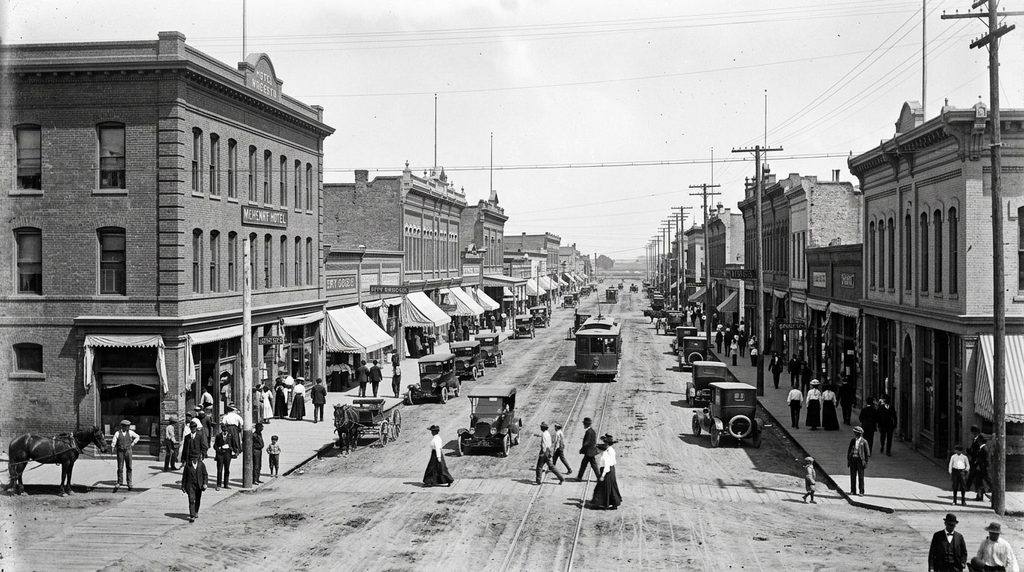
Modesto grew rapidly enough that residents sought to move the county seat there. An election in 1871 resulted in Modesto becoming the fifth and permanent county seat of Stanislaus County. This strengthened its position as an emerging center of government, business, transportation, and commerce.
Water Transforms the Modesto Landscape
If the railroad helped create Modesto, irrigation helped transform the region surrounding it.
Early farmers faced a basic challenge: the Central Valley had fertile soil, but dependable water was needed to develop more intensive agriculture. The solution would eventually change not only farming but also land values, settlement patterns, and the local economy.
The Rise of the Modesto Irrigation District
The Modesto Irrigation District traces its roots to California’s Wright Act of 1887, which allowed communities to organize public irrigation districts. Modesto became one of the earliest communities to use the new system.
Building the infrastructure was neither simple nor immediate. Engineers, farmers, landowners, and local leaders spent years dealing with financing, construction, legal disputes, dams, and canals. MID’s canal system was completed in 1903, and the first official irrigation season began in 1904.
From Grain Fields to Orchards
The arrival of reliable irrigation changed what farmers could grow. Large areas once associated with dry farming and grain could support orchards, vineyards, and other higher-value crops. Agriculture became increasingly important to Modesto’s growth and to the wider economy of Stanislaus County.
The connection between water and prosperity became so central to local identity that it eventually appeared in one of Modesto’s most recognizable civic symbols.
The Modesto Arch Becomes a City Landmark
The Modesto Arch was created during an era when growing American communities often promoted themselves through ambitious civic improvements and public symbols.
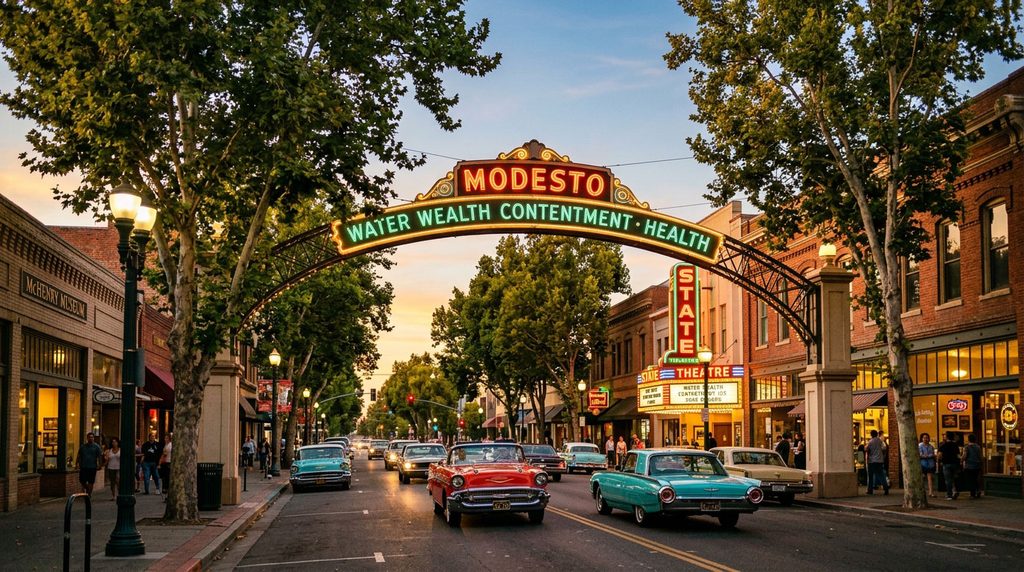
According to the City of Modesto’s historic landmark guide, the Modesto Business Men’s Association proposed an ornamental electric arch in 1911. The structure was dedicated in 1912.
Its famous slogan, “Water Wealth Contentment Health,” reflects the optimism of the period and the importance residents placed on irrigation and economic growth. More than a century later, the arch remains one of the city’s most recognizable landmarks.
Historic Homes Tell Another Part of the Story
Not all of Modesto’s history is found in major civic structures. Houses, neighborhoods, churches, commercial buildings, and public spaces provide evidence of how residents actually lived as the city developed.
McHenry Mansion and Victorian Modesto
One of the best-known surviving examples is McHenry Mansion. According to the McHenry Mansion’s official history, Robert and Matilda McHenry constructed the High Victorian Italianate home in 1883.
Robert McHenry had interests in agriculture and banking and became an important figure in the early community. The mansion later served several other purposes before preservation efforts restored it. Today, it provides visitors with a physical connection to nineteenth-century Modesto.
Across the city, other historic properties reveal additional chapters. Bungalows, commercial buildings, civic structures, and neighborhood streetscapes document Modesto’s transition from a small railroad settlement into a larger twentieth-century city.
Cars Become Part of Modesto’s Cultural Identity
By the middle of the twentieth century, Modesto was changing again. Automobiles shaped suburban growth, commercial development, social life, and youth culture throughout California.
In Modesto, cruising became particularly memorable. Young people drove the city’s streets, gathered at restaurants and drive-ins, listened to music, and turned automobiles into a form of social identity.
George Lucas and American Graffiti
Modesto’s cruising culture later received international attention because of filmmaker George Lucas, who was born in Modesto and drew on his experiences growing up there when developing American Graffiti.
The 1973 film depicted teenage life and cruising culture in 1962. Modesto continues to celebrate that connection through its annual Graffiti Summer traditions. The City of Modesto’s Graffiti Summer program highlights classic cars, cruising history, music, and events connected with this part of the community’s heritage.
This cultural legacy gives Modesto history an unusual dimension. The city’s past is not defined only by nineteenth-century pioneers and historic buildings. Twentieth-century popular culture has become part of its historical identity as well.
Preserving Modesto History Today
Historic preservation continues to matter as Modesto changes. Older structures face redevelopment, alteration, changing land uses, and the ordinary effects of time.
In 2025, the city conducted an update of its Downtown Historic Resources Inventory. Modesto’s Landmark Preservation Commission formally accepted that update in January 2026. The work reviewed designated landmarks and numerous other properties, including buildings associated with the historic Bungalow District.
These surveys matter because local history is easier to understand when buildings, records, photographs, maps, and neighborhood patterns can still be studied. Preservation does not require a city to remain unchanged; rather, it provides a way to recognize which places help explain how that city developed.
Why the History of Modesto Still Matters
The history of Modesto, California, is a story of adaptation. The railroad created an opportunity for a new community. Irrigation transformed agriculture. Historic neighborhoods documented periods of growth. Automobiles created new forms of social life, while local experiences eventually influenced American popular culture.
Today, landmarks such as McHenry Mansion and the Modesto Arch coexist with modern neighborhoods, businesses, farms, highways, and cultural institutions. Together, they show how different eras have contributed to the city’s character.
Learning about these places also makes everyday surroundings more meaningful. A familiar street may once have been a major cruising route. An older house may represent an architectural period that transformed an entire neighborhood. A canal may be part of a water system that changed the economic future of the region.
Modesto’s past is therefore not confined to museums or archival photographs. It remains visible throughout the community for anyone willing to look closely.
Continue Exploring Modesto’s Past
There are many more stories behind Modesto’s landmarks, historic homes, neighborhoods, agricultural traditions, transportation routes, and cultural landmarks. Visit our Modesto history articles to continue exploring the people and places that helped shape the city and the surrounding Stanislaus County region.